
The Future of AI Infrastructure: Why Deployment Speed Matters More Than Ever
The AI race is no longer defined solely by who builds the most powerful models or secures the latest GPUs. Increasingly, success depends on how quickly organizations can deploy the infrastructure that powers them.
According to McKinsey, companies are projected to invest approximately US$6.7 trillion in global data center infrastructure by 2030 to meet growing compute demand. Meanwhile, JLL forecasts that global data center capacity will nearly double from 103 GW in 2025 to 200 GW by 2030, driven largely by AI infrastructure expansion. Hyperscalers, neocloud providers, and enterprises are investing at unprecedented levels to support the next generation of AI workloads.
Yet despite record investment, compute is only part of the equation.
The industry’s greatest challenge has shifted to infrastructure delivery.
Power availability, cooling capacity, electrical equipment, engineering resources, supply chains, and commissioning have become just as critical as GPUs themselves. When key components such as transformers and switchgear require months—or even years—to procure, and AI hardware evolves faster than facilities can be built, deployment speed becomes the defining factor in how quickly organizations can turn investment into operational AI capacity.
The conversation has evolved.
Instead of asking “Can we get the GPUs?”, organizations are increasingly asking:
“How quickly can we build the infrastructure to run them?”
AI Is Redefining How Data Centers Are Built
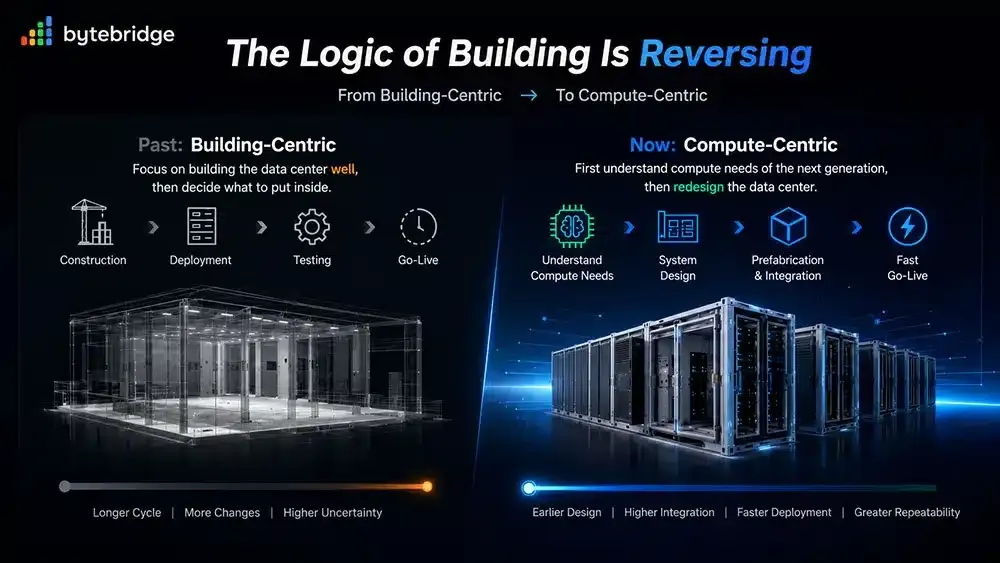
For decades, data center construction followed a predictable pattern.
Organizations designed and built facilities first. Power and cooling infrastructure were installed. IT equipment was deployed later. The building served as the foundation, while compute requirements were addressed afterward.
This approach worked because technology evolved relatively slowly.
Artificial intelligence has fundamentally changed that equation.
Today’s AI platforms require significantly higher rack densities, greater power capacity, advanced networking architectures, and sophisticated thermal management. Infrastructure requirements are no longer changing every few years— they are changing with every new generation of AI hardware.
As a result, organizations are no longer designing facilities and deciding what hardware goes inside later.
They are increasingly starting with compute requirements and designing infrastructure around them.
The logic of data center design is reversing.
Why Compute Is Driving Infrastructure Change
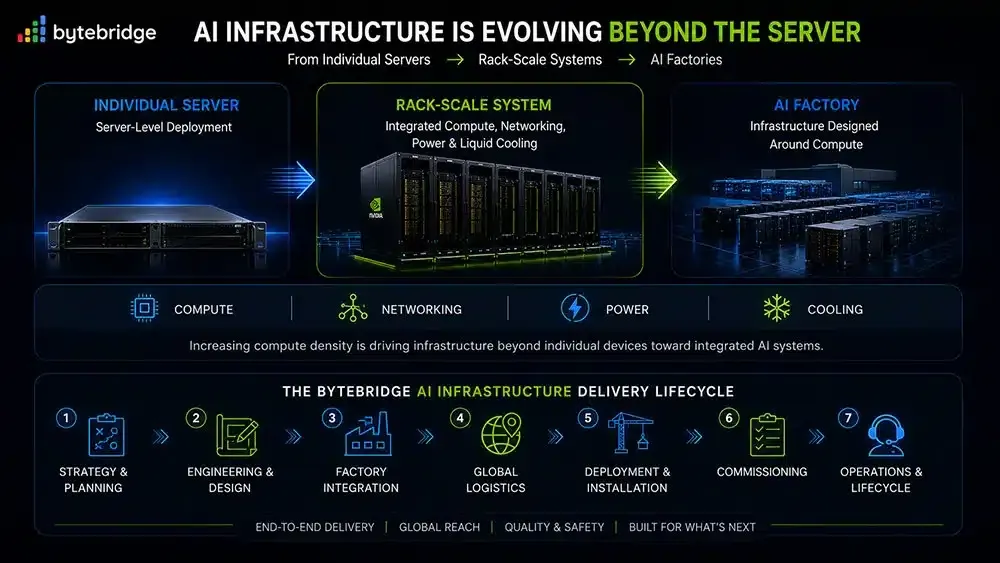
Modern AI infrastructure is evolving beyond individual servers.
The industry is rapidly moving toward rack-scale systems and AI Factories, where compute, networking, power distribution, and cooling are engineered as one integrated platform.
This shift is being driven by the growing demands of AI workloads.
As model sizes increase and training clusters expand, the basic unit of deployment is changing. Instead of optimizing individual servers, organizations are increasingly designing entire racks—and eventually entire facilities—as unified systems.
Rack-scale architectures integrate multiple GPUs, CPUs, networking components, power distribution systems, and liquid cooling infrastructure into a tightly coupled environment. AI Factories take this concept further, extending optimization across entire clusters and campuses.
This evolution has significant implications for infrastructure.
Higher compute density requires new power architectures.
Higher thermal loads require advanced liquid cooling solutions.
More interconnected systems require more sophisticated networking designs.
Rather than simply supporting compute, infrastructure now forms part of the compute architecture.
This is why planning for AI infrastructure now starts with understanding future workload requirements rather than available floor space.
The New Bottleneck Is Infrastructure Delivery
For years, discussions around AI infrastructure focused primarily on semiconductor supply.
Could organizations secure enough GPUs?
Would manufacturing capacity keep pace with demand?
Those questions remain important—but they are no longer sufficient.
Even after compute hardware is secured, organizations must still overcome a growing list of infrastructure constraints before AI workloads can go live.
Power availability remains a major challenge in many regions.
Transformers, switchgear, UPS systems, and cooling equipment often involve extended procurement timelines.
Engineering resources are increasingly stretched.
Supply chains remain under pressure.
Commissioning large-scale AI environments has become significantly more complex.
Each challenge represents a potential delay between purchasing AI hardware and generating value from it.
For organizations investing millions or billions of dollars in AI infrastructure, every month of delay matters.
Deployment speed has become a business metric, directly influencing how quickly organizations can generate value from AI investments.
Why Traditional Construction Is Falling Behind
Traditional data center construction was designed for a different era.
Projects typically progress through sequential phases:
- Design.
- Procurement.
- Construction.
- Installation.
- Testing.
- Commissioning.
Many activities cannot begin until previous phases are completed.
While this approach has served the industry for decades, it becomes increasingly difficult to sustain when AI infrastructure requirements continue evolving throughout the project lifecycle.
By the time a conventionally delivered facility becomes operational, organizations may already be planning deployment of the next generation of compute platforms.
Success depends on compressing delivery timelines without compromising quality, consistency, or scalability.
Modular Infrastructure Is About Delivery, Not Containers
When people hear the term modular data center, many immediately think of shipping containers.
In reality, modularity is less about physical form factor and more about transforming how infrastructure is delivered.
Traditional projects rely heavily on on-site assembly, integration, testing, and troubleshooting.
Modular delivery shifts much of that work into controlled factory environments.
Power systems, cooling infrastructure, controls, and supporting equipment can be pre-engineered, pre-integrated, and factory-tested before arriving on site.
Meanwhile, site preparation and civil construction continue in parallel.
This changes infrastructure delivery from a sequential process into a parallel one.
The result is faster deployment, greater consistency, reduced on-site risk, and improved repeatability.
For AI infrastructure, these benefits are becoming increasingly valuable.
The Next Competitive Advantage Is Deployment Speed
The first phase of the AI race was defined by access to compute.
The next phase will be defined by execution.
Owning thousands of GPUs creates little value if supporting infrastructure cannot be deployed quickly enough to put those systems into production.
Organizations that can align engineering, manufacturing, logistics, deployment, commissioning, and operations into a coordinated delivery model will be better positioned to scale AI infrastructure efficiently.
Competitive advantage is increasingly determined by execution. As AI hardware becomes more widely available, the ability to deliver supporting infrastructure quickly is emerging as the real differentiator.
The organizations that deploy faster will innovate faster.
Accelerating AI Infrastructure Delivery with ByteBridge
Delivering AI infrastructure at scale requires more than products.
It requires coordination across the entire project lifecycle.
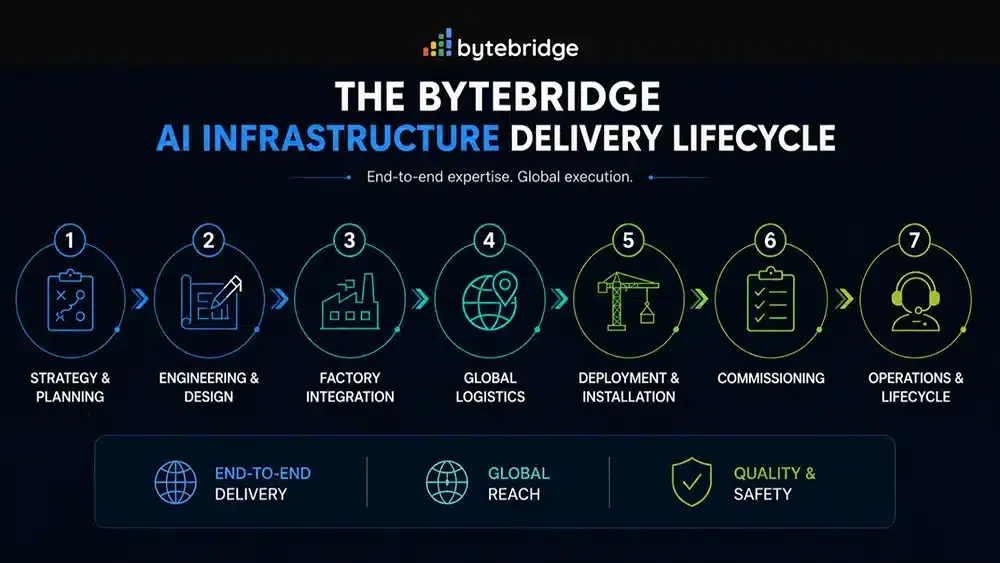
ByteBridge helps organizations accelerate AI infrastructure deployment through integrated capabilities spanning design, engineering, factory integration, global logistics, deployment, commissioning, and long-term operational support.
Working alongside a global ecosystem of leading technology partners, ByteBridge supports the delivery of AI-ready infrastructure that balances performance, flexibility, compliance, and scalability.
With project delivery capabilities spanning six continents, ByteBridge helps hyperscalers, neocloud providers, enterprises, and colocation operators execute infrastructure projects consistently across regions while maintaining local responsiveness.
Building AI Infrastructure for What's Next
AI is changing far more than the hardware inside a data center.
It is changing the way data centers are designed, engineered, and delivered.
The organizations that succeed in the AI era will not simply be those that acquire the most compute.
They will be those that can deploy infrastructure faster, scale more efficiently, and continuously adapt as AI technologies evolve.
The future of AI infrastructure will be shaped by how quickly facilities can become AI-ready.
At ByteBridge, we help organizations bridge the gap between infrastructure strategy and execution—transforming complex AI infrastructure projects into operational environments built for performance, delivered at scale, and ready for what’s next. Contact now.