
Zero-Touch Deployment in China: Integrating Apple Business Manager with Local MDM for Seamless Fleet Onboarding
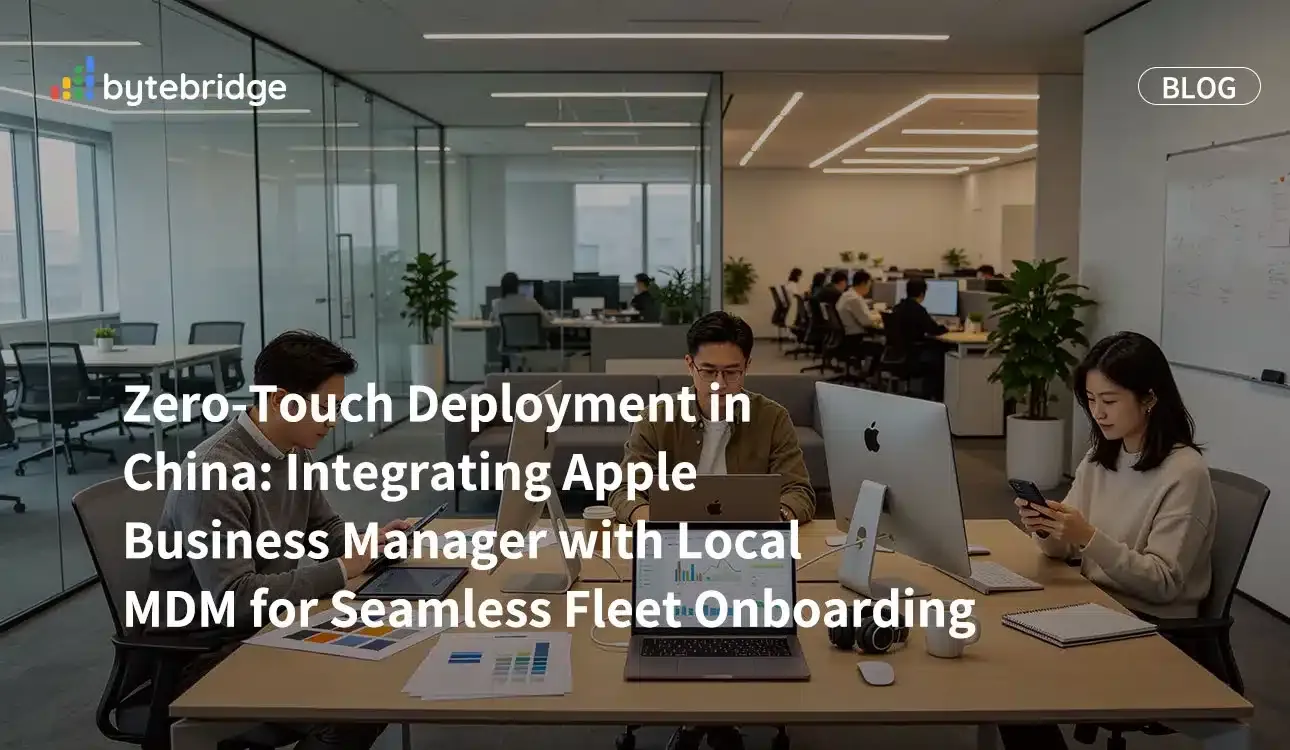
You have secured compliant procurement channels, modeled total cost of ownership, and established zero-trust security policies. Yet many organizations still face a critical gap: getting devices into employees’ hands without manual IT intervention. In mainland China, achieving true zero-touch deployment requires navigating unique infrastructure realities that global playbooks rarely address.
Apple Business Manager in the Chinese Context
Apple Business Manager (ABM) is now fully operational in mainland China, but the onboarding process differs from global deployments. Invoice verification requires authorized reseller documentation that matches your ABM organization name exactly—a common failure point for entities using third-party purchasing agents. Data residency considerations also apply; while ABM itself is accessible, associated services may route through domestic infrastructure, affecting sync timing and API responsiveness. Organizations must validate their reseller’s ABM authorization status before purchase to avoid orphaned device records.
Evaluating the MDM Stack for Mainland Operations
The deployment stack comprises three layers: ABM, MDM/UEM software, and local integration support. Global platforms like Jamf and Microsoft Intune offer robust feature sets but may experience latency behind the Great Firewall during initial enrollment. Domestic alternatives such as Shenzhou Digital or Ruichi Tech provide optimized network performance and native integrations with WeChat Work, DingTalk, and Lark—critical for user communication and self-service workflows. Selection criteria should prioritize ICP compliance, local support SLAs, identity federation capabilities with domestic IdPs like Aliyun IDaaS, and proven performance within Chinese network conditions. Hybrid approaches, pairing global MDM feature richness with local acceleration services, are increasingly common for multinational corporations.
Architecting a Compliant Zero-Touch Workflow
A China-optimized workflow begins with network preparation. IT teams must whitelist Apple’s deployment endpoints and configure CDN caching for configuration profiles and OS updates to reduce enrollment time. Identity federation presents another localized challenge: while Azure AD or Okta may serve as primary directories, integrating with local IdPs ensures seamless authentication during Setup Assistant without cross-border latency. App distribution via Volume Purchase Program requires awareness that certain applications are unavailable or restricted in the CN App Store; pre-validating app availability prevents deployment failures. For iPhone and iPad fleets, supervised mode activation and carrier policy alignment must be configured before devices leave the warehouse.
Measuring Deployment Success
Zero-touch is only valuable if it delivers measurable outcomes. Track time-to-productivity from unboxing to first login, helpdesk ticket volume related to setup issues, and enrollment success rates across locations. Industry benchmarks for mature APAC deployments target under 15 minutes from power-on to productive state and a 98%+ first-attempt enrollment rate. Calculate ROI by comparing labor hours saved against traditional imaging or manual configuration methods; most organizations achieve payback within six months at scale.
Completing the Lifecycle Loop
This deployment layer connects your previous investments in compliant sourcing, TCO modeling, zero-trust architecture, and end-of-life planning into a unified operational framework. Devices purchased through authorized partners flow seamlessly into ABM, receive policy-compliant configurations via optimized MDM, and generate accurate lifecycle data for future refresh planning. Looking ahead, Apple Intelligence and on-device AI capabilities will introduce new deployment considerations around model provisioning and privacy controls—making today’s infrastructure foundation essential for tomorrow’s requirements.
Achieving zero-touch in China is not about replicating global templates but adapting them to local realities. Audit your current deployment pipeline against these criteria, evaluate whether your MDM partner can deliver at scale within mainland infrastructure, and close the gap between procurement excellence and operational execution. Contact Us now!
Read more
- The Critical Role of Warehousing and Kitting Services for GSI and Enterprise Customers
- Optimizing Internet Data Center Performance with Advanced Networking Solutions Services
- Scaling Apple in China: From Compliant Buying to Sustainable Operations
- The End-of-Life Imperative: Maximizing Residual Value and Ensuring Secure Data Sanitization for Your Apple Fleet in China